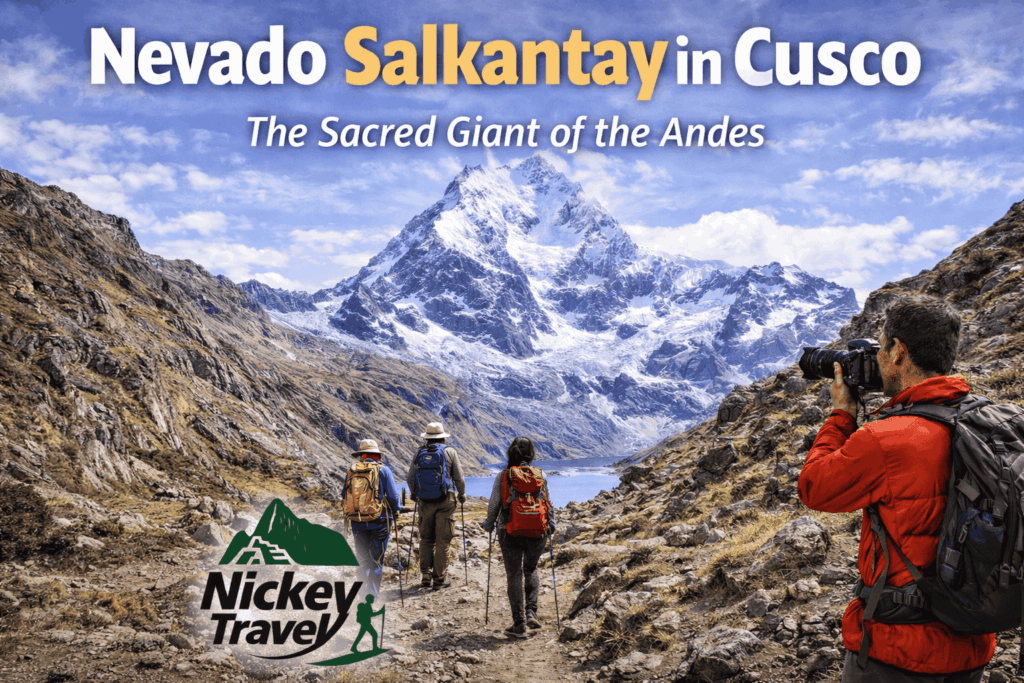
The Nevado Salkantay in Cusco is one of Peru’s most dramatic and spiritually powerful mountains. Towering at 6,271 meters (20,574 ft), it dominates the Vilcabamba mountain range and stands as one of the most iconic snow-capped peaks in the southern Andes.
More than just a mountain, Salkantay represents strength, sacred energy, biodiversity, adventure, and living Andean identity.
Meaning of the Name “Salkantay”
The word Salkantay comes from the Quechua language and is commonly interpreted as:
“Savage Mountain”
“Wild Mountain”
“Untamed Spirit”
The name reflects both its rugged, imposing appearance and its sacred spiritual presence in Andean cosmology.
Local communities consider Salkantay one of the most powerful Apus (sacred mountain spirits) — a guardian of valleys, water sources, and agricultural fertility.
Altitude and Geographic Significance
Elevation: 6,271 meters (20,574 ft)
Location: Vilcabamba Range, northwest of Cusco
Distance from Cusco: Approximately 60 km
It is the highest peak of the Vilcabamba mountain range and one of the highest in southern Peru.
Its glacial system feeds rivers that supply agricultural zones and rural communities.
First Ascent and Mountaineering History
Nevado Salkantay was first successfully climbed in 1952 by a Swiss expedition.
Since then, it has been ascended by experienced mountaineers, though it remains technically demanding due to:
Glaciated terrain
Steep ice walls
Deep crevasses
Sudden weather changes
Unlike trekking routes, summiting Salkantay requires advanced alpine climbing skills.
The number of ascents remains relatively limited compared to other Andean peaks due to its technical difficulty.
Geological Formation
Salkantay is part of the Andes Mountain system, formed through tectonic uplift caused by the collision of the Nazca Plate and the South American Plate.
Its dramatic glaciated summit and sharp ridges are shaped by:
Today, climate change is affecting its glacier mass, making it an important indicator of environmental change in the Andes.
Flora Around Nevado Salkantay
The region around the Nevado Salkantay in Cusco features diverse ecological zones due to extreme altitude variation.
High Andean Zone (above 4,000 m):
Ichu grass
Cushion plants
Mosses and lichens
Mid-Altitude Cloud Forest:
Polylepis (Queuña trees)
Orchids
Ferns
Bromeliads
Lower Jungle Transition:
This ecological transition makes the Salkantay region one of Peru’s most biodiverse trekking corridors.
Fauna of the Salkantay Region
Wildlife includes:
The variety of species increases dramatically as trekkers descend from high alpine zones into cloud forests.
Climate and Weather
The climate varies significantly by altitude.
High Mountain (Above 4,500 m)
Cloud Forest Zone
Warmer temperatures
Higher humidity
Frequent mist and rain
Best season: May to September (dry season).
Cultural and Spiritual Importance
For Andean communities, Salkantay is not just geography — it is spirituality.
It is considered:
A protector of the Sacred Valley
A spiritual mediator between earth and sky
A source of agricultural blessing
Traditional ceremonies still honor the mountain as a living entity.
The Salkantay Trek
The Salkantay Trek is one of the most spectacular alternative routes to Machu Picchu.
Key highlight:
Salkantay Pass – 4,650 meters (15,255 ft)
The trek allows travelers to experience:
It is considered moderately to highly challenging but does not require technical climbing.
Fascinating and Lesser-Known Facts
Salkantay is visible from parts of Machu Picchu on clear days.
It is one of Peru’s most photographed peaks after Ausangate.
Its glaciers are shrinking due to climate change.
The trek was ranked among the world’s top alternative hikes by international travel media.
The mountain influences regional water systems critical to Cusco agriculture.
Who Should Visit Nevado Salkantay?
Ideal for:
Final Reflection
Standing before the Nevado Salkantay in Cusco is not just witnessing a mountain — it is encountering one of the Andes’ most powerful natural and spiritual icons.
👉 [Insert booking link here]
Experience the raw power of the Andes.