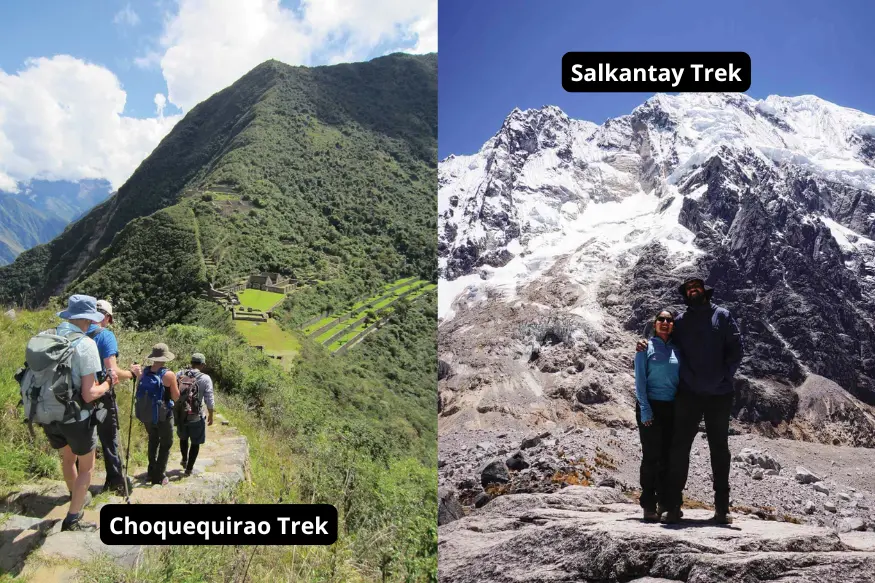
If you’re dreaming of an unforgettable hiking experience in the Peruvian Andes, you’ve probably heard about two of the country’s most legendary routes: the Choquequirao Trek and the Salkantay Trek.
Both offer breathtaking mountain landscapes, ancient Inca heritage, and a deep connection with nature — yet they deliver completely different experiences.
In this in-depth guide, we’ll compare Choquequirao Trek vs Salkantay Trek in every aspect: difficulty, altitude, scenery, logistics, cost, best season, and who each trek is perfect for.
By the end, you’ll know exactly which route matches your adventure style.
Overview of the Two Treks
The Choquequirao Trek
Hidden deep within the Apurímac Canyon, Choquequirao — “Cradle of Gold” in Quechua — is considered Machu Picchu’s sister city. Reached only on foot, this route is one of the most authentic and least crowded experiences in the Andes.
The classic itinerary takes 4 to 5 days, though extended versions can connect to Machu Picchu in 8 to 9 days. Expect steep ascents, dramatic landscapes, and total immersion in nature and solitude.
The Salkantay Trek
The Salkantay Trek is the most popular alternative to the Inca Trail. This route crosses the high-mountain pass near the sacred Salkantay Peak (6,271 m) and continues through cloud forests until reaching Machu Picchu.
It’s famous for its visual diversity — from snow-covered mountains to tropical valleys — and for its mix of comfort and adventure. The standard duration is 5 days / 4 nights, though shorter or upgraded versions exist.
Quick Comparison Table
| Feature | Choquequirao Trek | Salkantay Trek |
|---|
| Main Destination | Choquequirao Ruins | Machu Picchu |
| Duration | 4 – 5 days (standard) / 8 – 9 days (extended) | 4 – 5 days |
| Altitude Range | 1,500 m – 4,200 m | 2,000 m – 4,650 m |
| Difficulty Level | Challenging – steep and remote | Moderate to Challenging |
| Scenery | Canyon views, lush valleys, Inca ruins | Glaciers, lakes, jungles, Andean villages |
| Crowds | Very few trekkers | Popular route with more groups |
| Accommodation | Camping only | Camping or eco-lodges |
| Connection to Machu Picchu | Optional (add days to connect) | Included as final destination |
| Type of Experience | Raw adventure & archaeology | Scenic diversity & comfort |
The Choquequirao Trek – The Lost City Adventure
1. The Route
Your journey begins in the small town of Capuliyoc, a few hours from Cusco. From there, you descend nearly 1,500 meters to the Apurímac River, cross a hanging bridge, and then face a long, demanding ascent to reach the ancient citadel of Choquequirao.
The site itself sits majestically at 3,050 meters, overlooking deep valleys and snow-capped peaks. Unlike Machu Picchu, Choquequirao remains largely unexcavated and receives only a handful of visitors each day.
2. Scenery
Expect changing microclimates — from semi-tropical canyon vegetation to high-Andean grasslands. Condors often soar overhead, and llamas roam the terraces surrounding the ruins. The panoramic views of the Apurímac Canyon are among the most spectacular in Peru.
3. Difficulty
Make no mistake — this trek is physically demanding. You’ll be hiking 6 to 9 hours a day, often on steep switchbacks under the sun. Good fitness, trekking poles, and mental determination are key.
4. What Makes It Unique
Deep sense of isolation and discovery.
Authentic Inca ruins far from tourist crowds.
Opportunity to connect with local Quechua villages.
True wilderness camping experience.
5. Ideal for You If You…
Want to escape tourist crowds.
Prefer raw adventure and solitude.
Love archaeology and ancient history.
Are in excellent physical shape and well-acclimatized.
The Salkantay Trek – The Scenic Path to Machu Picchu
1. The Route
Starting near Mollepata, the trek gradually ascends to the breathtaking Salkantay Pass (4,650 m), surrounded by glaciers and turquoise lakes.
After conquering the pass, the trail descends into warm valleys filled with orchids, waterfalls, and tropical forests before arriving at Aguas Calientes, the gateway to Machu Picchu.
2. Scenery
This trek delivers stunning contrasts: snowy peaks, green valleys, Andean farms, and jungle foliage. One of the highlights is the emerald-colored Humantay Lake, often visited on the first day.
3. Difficulty
The Salkantay Trek is moderately challenging, with one tough day crossing the high pass but generally gentler terrain afterward. With proper acclimatization, most hikers find it demanding but manageable.
4. Accommodation & Comfort
Depending on the operator, you can choose camping or more comfortable eco-lodges with beds, hot showers, and gourmet meals. That makes it one of the most accessible multi-day hikes in Peru.
5. Ideal for You If You…
Want to reach Machu Picchu on foot.
Enjoy diverse landscapes and moderate comfort.
Prefer a balance between adventure and ease.
Have limited time but want a spectacular trek.
Difficulty & Physical Preparation
| Aspect | Choquequirao | Salkantay |
|---|
| Daily Hours of Hiking | 6 – 9 hrs | 5 – 8 hrs |
| Steep Sections | Very steep descents and ascents | Moderate with one high pass |
| Terrain Type | Rocky and rugged | Mixed – mountain trails and valley paths |
| Fitness Required | High | Medium to High |
| Altitude Sickness Risk | Moderate | Higher at the pass |
Regardless of which route you choose, spend at least two days in Cusco to acclimatize. Train with cardio and hiking practice before arrival.
Scenery & Highlights Compared
Choquequirao Highlights
The breathtaking Apurímac Canyon viewpoints.
Extensive Inca ruins with terraces, plazas, and ceremonial areas.
Chance to camp beneath a sky filled with stars.
Authentic contact with isolated Andean communities.
Salkantay Highlights
Crossing the majestic Salkantay Pass with snowy mountain views.
Visiting Humantay Lake, a vivid turquoise glacial lagoon.
Descending through lush cloud forests to Aguas Calientes.
Finishing with a guided tour of Machu Picchu.
Accommodation & Logistics
Choquequirao
Expect camping every night. Most groups carry tents, sleeping bags, and supplies on pack horses. There are basic toilets and occasional rustic shelters, but no lodges or restaurants. It’s ideal for adventurers who enjoy simplicity and self-reliance.
Salkantay
You can choose between classic camping and more comfortable lodge options. Several eco-domes and mountain huts offer beds, showers, and meals. It’s a great choice for those who want comfort without losing the sense of adventure.
💰 Cost Comparison
| Category | Choquequirao Trek | Salkantay Trek |
|---|
| Average Price (Shared Group) | ≈ $530 – $570 USD | ≈ $540 – $600 USD |
| Private Option | +$100 – $150 USD | +$100 – $150 USD |
| Included Services | Transport, guide, meals, camping gear, horses | Transport, guide, meals, camping or lodges, train back |
| Extras | Sleeping bag, trekking poles rental | Entrance to Humantay Lake, optional hot springs |
Prices are approximate and depend on operator and season.
Best Time to Trek
Both routes can be done year-round, but the dry season (from April to October) is widely considered the best time for clear skies and safe trail conditions.
May – September: Ideal weather, crisp mountain views, cool nights.
November – March: Rainy season, muddy trails but lush green valleys.
If you prefer fewer crowds and mild weather, April or October are excellent shoulder months.
Cultural and Spiritual Connection
Both treks are deeply connected to Andean cosmovision and Inca heritage.
Choquequirao is a place of spiritual silence, where you can feel the mystery of an unrestored Inca citadel still hidden in the mountains.
Salkantay derives its name from the sacred Apu Salkantay, one of the most revered mountains in Quechua tradition. Crossing its pass is seen as a pilgrimage of respect to the spirits of the Andes.
Which One Is Right for You?
| Traveler Type | Best Choice | Why |
|---|
| Adventure Seeker / Experienced Trekker | Choquequirao | Remote, rugged terrain, challenging and authentic |
| Nature Lover & Photographer | Salkantay | Diverse ecosystems, glacial lakes, landscapes |
| History & Ruins Enthusiast | Choquequirao | Deep archaeological focus, unrestored Inca citadel |
| Comfort-Oriented Traveler | Salkantay | Better infrastructure, lodges, showers and beds |
| Traveler with Limited Time | Salkantay | Easier access, shorter transfer times |
| Traveler Seeking Peace and Isolation | Choquequirao | Minimal crowds and quiet trails |
Preparation Tips for Either Trek
Acclimatize in Cusco for at least 48 hours before starting.
Train your legs and lungs — practice hiking with a daypack.
Pack layers: temperatures can change from freezing to hot in a single day.
Essential items: good boots, trekking poles, waterproof jacket, sunscreen, and snacks.
Stay hydrated and eat light to avoid altitude issues.
Respect nature and local culture — leave no trace and support local communities.
Final Verdict: Choquequirao vs Salkantay
Both treks stand among the best hikes in Peru, but they appeal to different personalities.
Choose Choquequirao Trek if you want:
A remote and off-the-beaten-path adventure.
The thrill of discovering an ancient Inca city in solitude.
Challenging terrain and a sense of achievement few others feel.
Choose Salkantay Trek if you want:
To reach Machu Picchu on foot through spectacular landscapes.
More comfort and organized logistics.
A balance between mountain drama and lush green valleys.
In the end, there is no wrong choice — only different ways to connect with the heart of the Andes.
Whichever trek you choose, prepare well, travel responsibly, and let the mountains guide you to a journey you’ll never forget.